4. Flux
1 Quantitative Prediction of High-Energy Electron Integral Flux at Geostationary Orbit Based on Deep Learning
Wei, L., Zhong, Q., Lin, R., Wang, J., Liu, S., & Cao, Y. (2018). Quantitative prediction of high-energy electron integral flux at geostationary orbit based on deep learning. Space Weather, 16, 903–916. https://doi.org/10.1029/2018SW001829
1.1 简介
1.1.1 recurrent neural network (RNN)
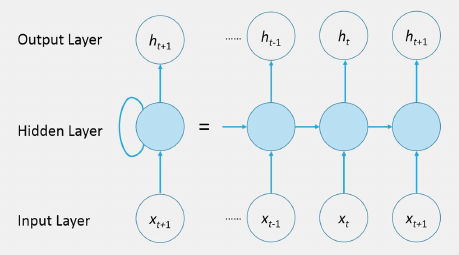
- Unlike traditional feed-forward neural networks, RNNs add loops in themselves, allowing information to be retained from a previous time to the next by iterative function loops
- The back-propagation trough time algorithm is used to adjust and renew the network parameters during the training process (residual calculation).
- equation:
- a gradient vanishing and explosion problem exists if the input sequence is too long
1.1.2 Long Short-Term Memory (LSTM)
| LSTM repeating module architecture | Meaning | Formulas |
|---|---|---|
| !401 | Blue circles: Neural network layers |
$$\begin{array}c\begin{array}c f_t = \sigma(W_f \cdot [h_{t-1},x_t] + b_f)\ i_t = \sigma(W_i\cdot [h_{t-1},x_t] + b_i) \ \widetilde{C}t = \tanh(W_c\cdot [h,x_t] + b_C) \ C_t = f_t * C_{t-1} + i_t * \widetilde{C}_t \ o_t = \sigma(W_o \cdot [h_t-1,x_t] + b_o) \ h_t = o_t * \tanh(C_t) \end{array} \[8pt] \begin{cases} \sigma(x) = \frac{1}{1+e^{-x}} \[3pt] \tanh(x) = \frac{{1-e^{-2x}}}{1+e^{-2x}} \end{cases}\end{array}$$ |
- Data Structure and Batch Processing
For time series[1,2,3,4,5], splitting toX=[[1,2],[2,3],[3,4],[4,5]]andy=[3,4,5,6]:
Xcontains 4 samples (batch_size=4), each sample is a sequence of length 2(time_step=2), andinput_size=1for 1D data series- The model processes these samples in batches, performing forward propagation independently for each sample
- Taking the first sample
[1, 2]as an example, the LSTM processing steps:- Time step 1: Process input
1, update hidden stateh1 - Time step 2: Process input
2, combine withh1to update hidden stateh2 - Extract features: Take the hidden state from the last time step
h2 - Prediction: Map
h2to a predicted value through a linear layer, compare with target value3
- Time step 1: Process input
- Parallelism in Batch Processing
- The model processes multiple samples simultaneously (depending on
batch_size) - For all 4 samples in
X, the LSTM executes the above processing steps in parallel - The processing of each sample is independent, and ultimately each sample yields a predicted value
1.1.3 Calibration
The logarithm of the daily electron integral flux from the three pairs of GOES satellites during the overlapped period has strong. linear correlations. Based on this, the values from different satellites are calibrated using the data of GOES-11 by using the method of linear fitting that covers the time period from January 1999 to December 2016.
In addition, piecewise linear fitting is used to calibrate the data from GOES-13 to GOES-11.
1.1.4 Model Result
Spearman’s rank correlation analysis
Unlike the more common Pearson correlation, which looks for linear relationships (straight lines), Spearman looks for monotonic relationships. This means it checks if, as one variable increases, the other tends to increase (corr>0) or decrease(corr<0), even if that change isn't a perfectly straight line.
For a dataset without many tied ranks, the formula is:
is the difference between the ranks of each observation. is the number of observations.
How to Calculate it in Python:
# Offset Time: Shifting 'sales' back by 2 periods
df['sales_lagged'] = df['sales'].shift(-2)

# Using scipy
from scipy import stats
x = [10, 20, 30, 40, 50]
y = [2, 2.4, 10, 8, 25]
coef, p_value = stats.spearmanr(x, y)
print(f"Spearman Correlation Coefficient: {coef:.3f}")
print(f"P-value: {p_value:.3f}")

# Using pandas for DataFrame
import pandas as pd
df = pd.DataFrame({'study_hours': [1, 5, 2, 8, 4], 'test_scores': [50, 88, 60, 95, 78]})
correlation_matrix = df.corr(method='spearman')
print(correlation_matrix)
- result:
!696
According to the correlation, the flux itself, solar wind velocity, Dst, and Kp indices are considered to be better input factors for modeling. The remaining parameters, with the exception of IMF, are also used as inputs for modeling.
The feature of offset time is an important factor of setting the time step in modeling to determine the number of consecutive days to be used as inputs to the model.